

How Are Digital Dosing Pumps Used in Industrial Water Treatment?
Industrial water treatment is not simply about moving water from one process to another. In many plants, treatment performance depends on controlling very small amounts of chemicals at the right time, concentration, and flow rate. Coagulants, pH regulators, disinfectants, corrosion inhibitors, and other treatment chemicals all need to be introduced according to the actual process requirements.
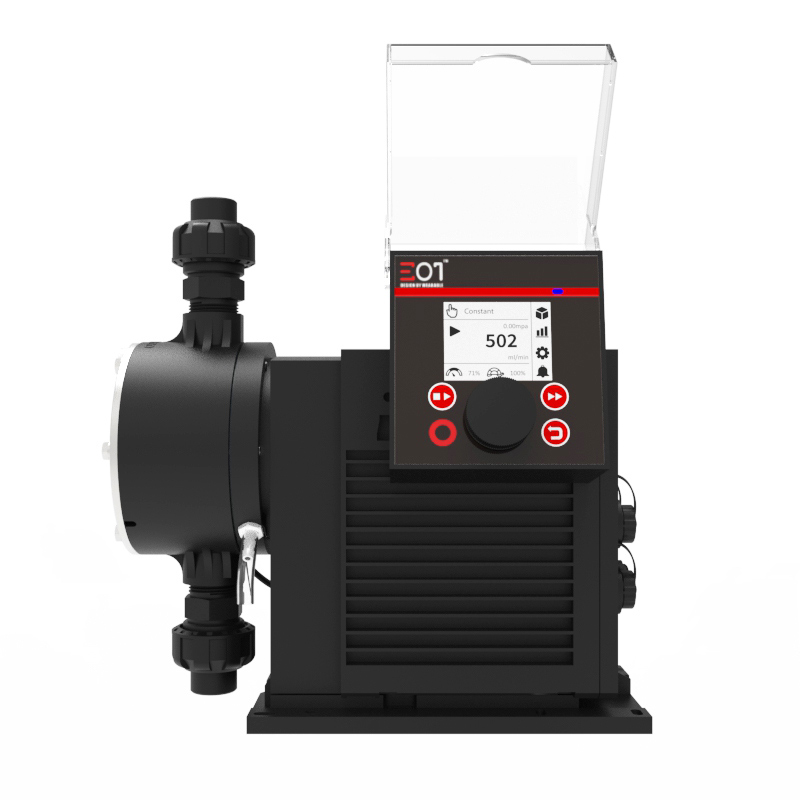
This is where a Digital Dosing Pump becomes an important part of the treatment system. Unlike a conventional pump that may operate at a relatively fixed dosing rate, a digital dosing solution can provide more flexible control over chemical flow and can be integrated with sensors, PLCs, and other automation systems. This makes it particularly useful when water quality or process conditions change continuously.
Why Is Precise Chemical Dosing Important in Industrial Water Treatment?
The amount of chemical required by a water treatment process is rarely constant. Raw water quality can change with production conditions, seasonal variations, contamination levels, flow rate, and other process parameters.
If too little chemical is injected, the treatment reaction may be incomplete. For example, insufficient coagulant can reduce the formation of effective flocs, while inadequate disinfectant dosing may compromise the required treatment performance. On the other hand, excessive dosing increases chemical consumption, operating costs, and in some processes may create additional treatment or disposal problems.
Chemical dosing therefore needs to be treated as a controlled process rather than simply a matter of keeping a pump running. Industry guidance and water-treatment practice recognize chemical type, dosage management, and application method as important elements of effective treatment.
A Digital Dosing Pump helps address this challenge by providing finer control over the dosing rate. The objective is not simply to dose more accurately for its own sake, but to keep the chemical concentration closer to what the treatment process actually requires.
How Are Digital Dosing Pumps Used in Water Treatment Processes?
The role of a digital dosing pump depends on the treatment stage and the chemical being introduced. In practice, the same basic pump technology can support very different control strategies.
pH Adjustment
pH control is one of the most common applications. Acid or alkaline chemicals can be dosed to bring process water toward a desired pH range. Because the required dosage can change as water chemistry changes, a fixed dosing rate may not always be sufficient.
A Digital Chemical Dosing Pump can adjust its output according to the control signal from the system. When combined with a pH sensor and controller, the dosing process can become part of an automatic feedback loop rather than relying entirely on manual adjustment. This is especially valuable in industrial processes where maintaining a stable pH is important for downstream filtration, chemical reactions, or discharge requirements.
Coagulation and Flocculation
In clarification processes, coagulants and polymers are used to destabilize suspended particles and promote floc formation. The effectiveness of this stage depends strongly on chemical dose and water characteristics. The U.S. EPA notes that coagulation performance is influenced by factors including pH and coagulant dosage, while jar testing can be used to evaluate suitable dosing conditions.
A dosing pump therefore needs to provide more than simple chemical transfer. It must deliver a repeatable amount of chemical so that operators can maintain consistent treatment conditions. For plants with changing flow rates, precision dosing becomes even more important because the required chemical feed may need to increase or decrease with the water flow.
Disinfection
Disinfection systems may use chemicals such as sodium hypochlorite or other approved disinfectants. The challenge is to provide sufficient chemical contact while avoiding unnecessary over-dosing.
A digital dosing system can help operators maintain a controlled chemical feed and adjust the rate according to process requirements. In more advanced systems, dosing equipment can receive signals from flow meters, chlorine analyzers, or centralized control systems.
Scale and Corrosion Control
Industrial cooling water, boiler systems, and process-water loops may require inhibitors or conditioning chemicals to control scaling and corrosion.
Here, the value of a Digital Dosing Pump is not simply its ability to move chemicals. Consistent dosing helps maintain the intended chemical concentration over extended operating periods. This can support equipment protection while reducing the risk of excessive chemical use.
How Does a Digital Dosing Pump Improve Industrial Water Treatment?
The major difference between digital and basic dosing approaches is the level of control available.
A traditional system may rely on a fixed stroke, fixed frequency, or simple start-stop signal. This can work when process conditions are stable, but industrial water treatment often operates under changing conditions. Digital dosing technology allows the pump output to be adjusted more dynamically. Digital dosing systems are specifically used in municipal and industrial applications where chemical quantities need to respond to measured water conditions.
More Precise Flow Control
A suitable Digital Dosing Pump can provide fine adjustment of the chemical flow rate. This is particularly useful when the required dosage is relatively small or when the operating range changes significantly throughout the day. The goal is to avoid the situation where the pump is technically operating but cannot provide the resolution needed at low flow rates.
More Consistent Chemical Delivery
Consistency matters because water treatment is a continuous process. Fluctuating chemical delivery can cause treatment conditions to move away from their target values even when the average dosing rate appears correct. Stable dosing helps create more predictable process conditions and gives operators better control over downstream treatment stages.
Easier Automation and Integration
For modern industrial plants, a dosing pump rarely operates as an isolated device. It may receive signals from flow meters, pH sensors, ORP instruments, analyzers, PLCs, or DCS systems. This allows the dosing rate to be linked to actual process conditions. For example, when water flow increases, the chemical feed can be adjusted accordingly rather than relying on an operator to make a manual change.
Lower Chemical Waste
More accurate dosing can also have an economic benefit. If a plant routinely adds a large safety margin to its chemical dosage, even a small reduction in unnecessary dosing can become significant over thousands of operating hours. However, chemical savings should not be assumed simply because a pump is digital — the actual result depends on system design, chemical characteristics, sensors, control logic, and process conditions.
> FLOW_CONTROL
Fine adjustment at low and high flow rates without losing resolution.
> DELIVERY_STABILITY
Consistent output keeps treatment conditions closer to target values.
> INTEGRATION
Connects with flow meters, sensors, PLCs, and DCS systems.
> CHEMICAL_EFFICIENCY
Reduces unnecessary safety-margin dosing over long operating periods.
Can Digital Dosing Pumps Handle Different Water Treatment Chemicals?
Yes, but pump selection must be based on the properties of the chemical rather than assuming one pump is suitable for every application.
Acids, alkalis, oxidizing agents, polymers, disinfectants, and corrosion inhibitors can differ significantly in corrosiveness, viscosity, concentration, temperature, and compatibility with wetted materials.
For this reason, the pump head, diaphragm, valves, seals, tubing, and other wetted components should be selected according to the chemical and operating conditions.
For example, a chemical that is highly corrosive may require specific materials, while a high-viscosity polymer may require a different dosing configuration from a low-viscosity disinfectant.
This is an important point for B2B buyers: chemical compatibility should be confirmed before selecting a Digital Dosing Pump, especially for OEM systems and customized industrial installations.

Where Are Digital Dosing Pumps Used in Industrial Water Treatment?
The application range extends well beyond one type of treatment plant. Digital dosing pumps can be incorporated into wastewater treatment, industrial process-water systems, cooling-water treatment, boiler-water treatment, filtration, reverse osmosis, and other chemical treatment processes.
In wastewater treatment, for example, dosing may be required for coagulation, flocculation, pH adjustment, disinfection, phosphorus removal, or sludge conditioning. Each application has different chemical and control requirements, meaning the pump should be selected according to the actual process rather than simply by nominal flow rate.
In industrial process water systems, the priority may instead be controlling corrosion, scaling, or water chemistry to protect production equipment.
This difference is important when specifying a chemical dosing system. The same flow capacity can have very different technical requirements depending on what chemical is being dosed and where it enters the process.
What Should Buyers Consider When Choosing a Digital Dosing Pump?
For distributors, engineering contractors, system integrators, and water-treatment equipment manufacturers, purchasing decisions should go beyond the initial pump price.
- Dosing capacity — should cover the required minimum, normal, and maximum flow range without sacrificing controllability at the lower end.
- System pressure — the pump must deliver chemical against the actual system pressure, including variations from piping, valves, filters, and injection points.
- Chemical compatibility — wetted materials should suit the chemical concentration, temperature, and operating environment.
- Control architecture — analog control, pulse control, alarm outputs, PLC/DCS connectivity, monitoring, and remote adjustment affect long-term usability.
Why Choose a Digital Dosing Pump for Industrial Water Treatment?
The strongest reason to choose a Digital Dosing Pump is not simply that it is a newer type of pump. Its value comes from giving the treatment system greater control over a variable process.
When water quality, flow rate, or chemical demand changes, the dosing system needs to respond without creating unnecessary chemical consumption or unstable treatment conditions. Digital control provides the flexibility needed to make that response more precise.
For B2B projects, this can translate into several practical benefits: better process consistency, easier automation, improved dosing management, and potentially lower chemical and maintenance costs over the equipment's service life.
Making Industrial Water Treatment More Precise
A Digital Dosing Pump is an important execution component within an industrial chemical dosing system. Its role extends from pH adjustment and coagulation to disinfection, scale control, corrosion protection, and other treatment processes.
The best results come when the pump, chemical, sensors, control system, and treatment process are designed as one integrated solution. For buyers, this means evaluating not only flow rate and price, but also chemical compatibility, control capability, operating range, reliability, and long-term service requirements.
When these factors are properly matched, digital dosing can turn chemical addition from a largely manual operation into a more measurable, controllable, and efficient part of industrial water treatment.
